
Preservation and Restoration of Sutter’s Fort
May 19th, 2026
The Impact of Friends of Sutter’s Fort
The work of preserving structures that are over 100 years old is an ongoing, daily task. In the past, the 501(c)(3), Friends of Sutter’s Fort committed to support these projects, providing critical funding for several major preservation projects valued at nearly $1M, including the painting of both interior and exterior walls and the restoration of the blacksmith shop. With the dissolution of the organization in 2026, Midtown Parks has stepped in to be a steward of the historic site alongside its partners at California State Parks. Some of the most notable past restoration projects from Sutter’s Fort can be seen below.
Background of Historic Structures
Sutter’s Fort State Historic Park (SHP) is a historic site that has a great deal of significance to both Sacramento and world history and is recognized as both a California Historical Landmark and a National Historic Landmark. Today, people visit Sutter’s Fort from throughout the world to better understand the history that led to the famous Gold Rush, the Bear Flag Revolt and to California becoming part of the United State of America.
The structures of Sutter’s Fort were the first non-Indigenous structures built in Sacramento and the site of the first non-native community in California’s Central Valley.
The Central Building of Sutter’s Fort is a two-story adobe structure built between 1841 and 1843, and it the oldest existing building in Sacramento.
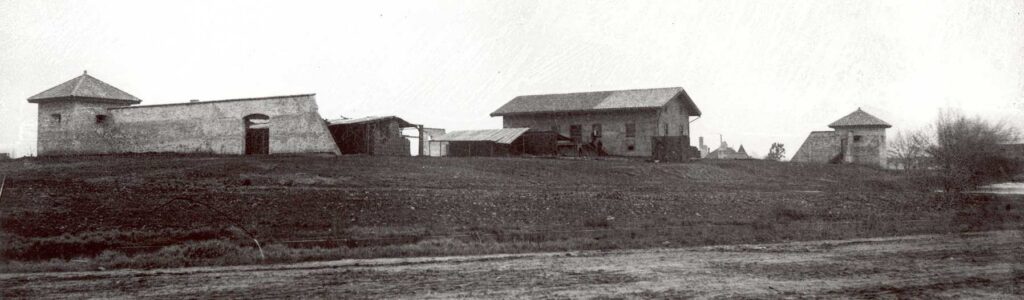
The exterior walls of Sutter’s Fort originally extended farther out than they do today. Sutter built the original fort with walls to be 2.5 feet thick and 15 to 18 feet high. When gold was discovered in 1848, the rush of immigrants to California seeking treasures brought the downfall of Sutter’s empire, and soon the Fort walls were dismantled and all that was left was the Central Building.
In 1891, the Native Sons of the Golden West spearheaded restoration efforts, rebuilding the walls of Sutter’s Fort. Completed in 1893, this restoration effort makes Sutter’s Fort the oldest restored Fort in the United States.
Sutter’s Fort was donated to the State of California, and became part of the California State park System in 1947. Today, the Fort is furnished and reconstructed to reflect its 1846 appearance.
Background of Historic Artifacts
In addition to the historic structures at Sutter’s Fort SHP, Friends of Sutter’s Fort also is committed the preservation of the many artifacts that are part of the Sutter’s Fort Collection. This expansive collection of artifacts is housed both at Sutter’s Fort, and at the State Museums Collections Center, which is also managed by California State Parks.
Artifacts include furniture, tools and artwork, along with thousands of photographs and documents. Due to the difficulty to control the environment in the historic structures of Sutter’s Fort, many of these items are not currently accessible to the public. It is our hope to provide future funding to expand the ability to exhibit these items for public viewing. We also hope to fund efforts to preserve and protect the artifacts.
New Shade Structure at Sutter’s Fort
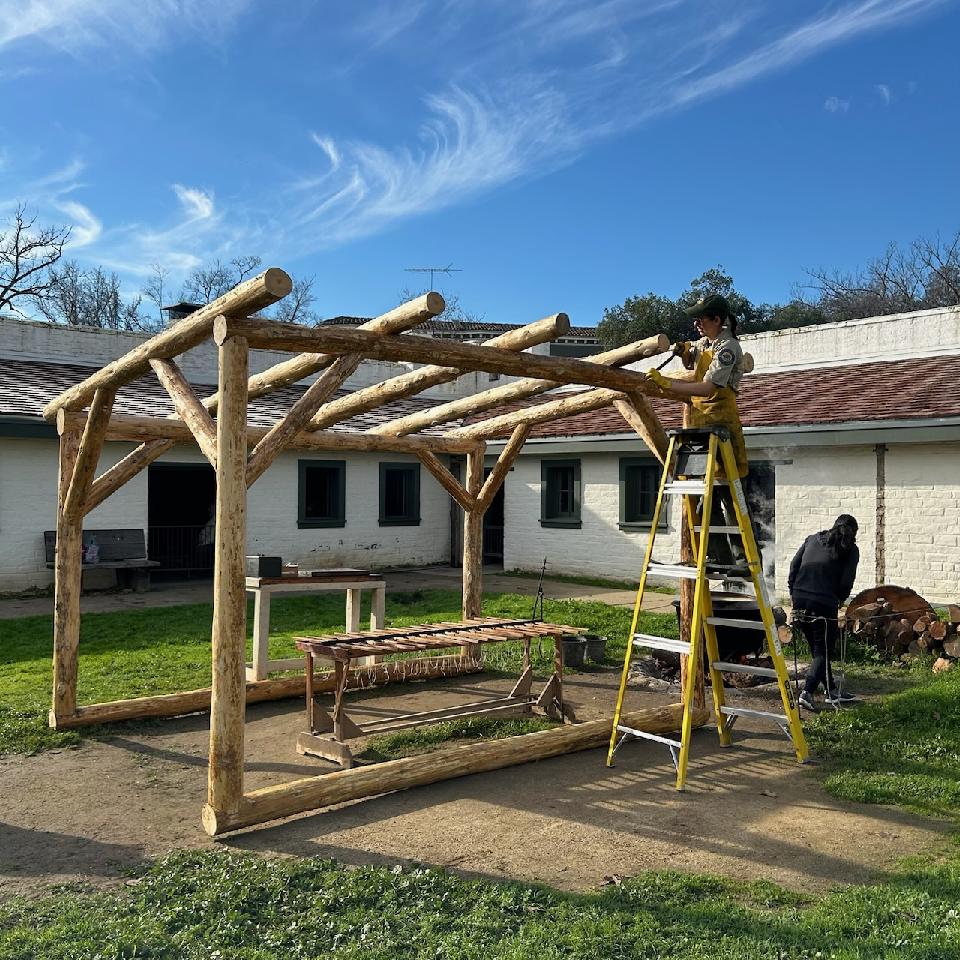
In an effort to enhance visitor comfort and preserve the historical integrity of Sutter’s Fort State Historic Park, California State Parks completed the construction of a new shade structure that will be used primarily for students during field trips as they handmake candles. This project exemplifies a blend of traditional craftsmanship and modern engineering, providing both function and historical representation.
California State Parks Restoration Supervisor Tim White worked closely with park staff to determine the requirements for the new shade structure, with a focus on historical accuracy and durability. Tim designed the structure using traditional saddle joint construction, a method that aligns with the mid-19th century techniques of the Fort’s period of significance.
To source the materials, California State Parks collaborated with Calaveras Big Trees State Park, where they hand-selected the logs needed for the project. Once chosen, Restoration Work Specialist Derek Kettenhofen debarked and prepared the timbers by hand. He meticulously constructed the structure based on Tim’s design, ensuring it reflected historical authenticity. For added strength and durability, especially given its exposure to the elements and the need for child safety, modern materials such as epoxy, bolts, and structural screws were incorporated into the build, carefully hidden behind wooden plugs to maintain the structure’s period-appropriate appearance.
Staircase Restoration Project
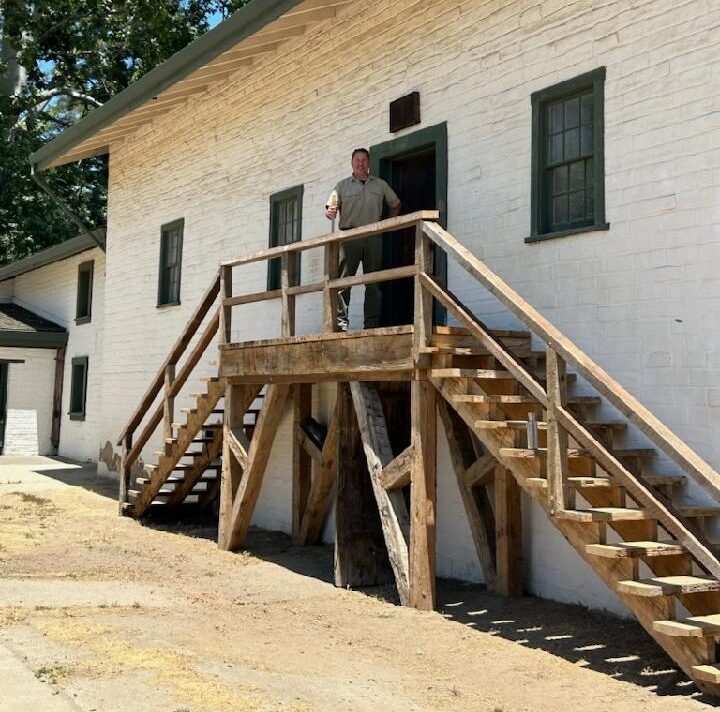
In 2023, California State Parks completed the rebuilding of the staircase on the western side of the Central Building at Sutter’s Fort. This project involved the design, construction, and installation of new stairs using reclaimed white oak salvaged from Midwestern barns. The team skillfully combined traditional building techniques with modern advancements, such as concrete post bases, bolts, and contemporary lag screws, ensuring the staircase remains structurally sound while preserving the historical character of the site. All modern materials were carefully concealed to maintain the authentic look and feel of the Fort.
The Central Building is the only original structure remaining at Sutter’s Fort State Historic Park, and over the years, its staircase has been replaced multiple times due to wear and tear. California State Parks took great care in this restoration, honoring the Fort’s legacy while enhancing safety and longevity.
South Gate Spiked Arch Restoration
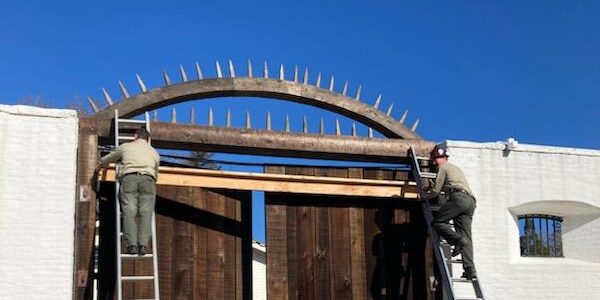
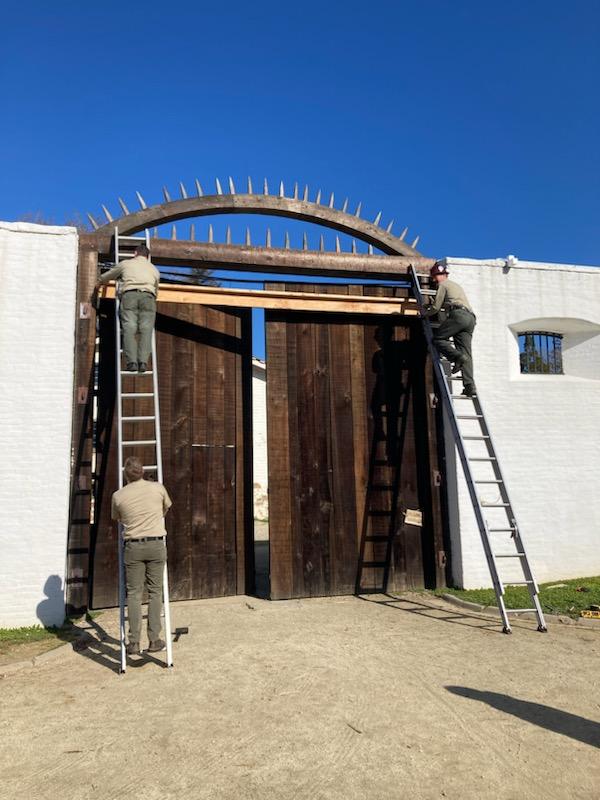
In 2022, California State Parks took swift action to address a critical issue at the South Gate of Sutter’s Fort State Historic Park. Staff noticed that the arched lintel above the main beam, which secures the large door posts at the Sutter’s Fort south entrance, was leaning, posing a potential safety hazard. To ensure visitor safety, the lintel was immediately removed for inspection and restoration.
Upon removal, the restoration team discovered that the wood was severely rotting. California State Parks restoration specialists secured replacement lumber and began the meticulous process of fabricating a new beam to match the original. Using period-appropriate techniques, the team hand-milled the lumber with saws featuring a tooth pattern typical of the era, and hand-hewed the beams with an adze to replicate the historic appearance.
A particularly striking feature of this project was the recreation of the forty spikes used in the arch. Each spike was individually hand-carved, giving them a unique, handcrafted appearance consistent with the historical period. To further enhance the restoration, a special treatment was applied to the new beam, providing an aged appearance while also offering rot resistance.
In 2023, While the original beam was removed, a temporary support was added to the South Gate to maintain structural integrity. The replacement beam was carefully crafted to match the original mortise and tenon joint configuration, ensuring that the South Gate will remain secure for years to come.
Media Room Renovation: Enhancing Visitor Experience at Sutter’s Fort
In a collaborative effort between California State Parks and Friends of Sutter’s Fort, and with generous support from donors and a Park Improvement Project Grant from the California State Parks Foundation, a significant renovation project was made in the Media Room at Sutter’s Fort State Historic Park. The purpose of this renovation was to transform the Media Room into a central hub for visitors to begin their self-guided tour of Sutter’s Fort SHP. With this project, our goal was to make the room more inviting, educational, and comfortable, enhancing the overall visitor experience. Friends of Sutter’s Fort worked closely with curatorial, interpretive, and administrative staff at California State Parks to design new interpretive signage and create a gallery of historical images that showcase Sutter’s Fort’s transformation over the past 100 years. This gallery allows visitors to see how the Fort evolved, sparking meaningful conversations and deeper engagement with the site’s history.
You can support the continued preservation and restoration of this historic park by donating to Midtown Parks and designating your donation to “Sutter’s Fort” here.